









- One sided adhesive tapes
- Packing tapes
- Coloured - marking tapes
- Electrical tapes
- Office tapes, adhesive tapes
- Slick surface tapes
- Metal adhesive tapes
- Masking crepe tape
- Masking special tapes
- Surface protection tapes
- Foam - sealing tapes
- Anti-slip tapes
- Self-adhesive rubber cut-outs
- Special tapes
- Textile tapes
- Warning and reflective tapes
- Double-sided adhesive tapes
- Electrical insulation material
- Glues
- Flexible stoppers, bumpers
- Velcro straps
- Primers - activators - cleaners
- Accessories for adhesives, applicators
Belts are not only a matter for people or social animals. Plants now also need passports on their travels.
If you may not be professionally involved in planting, breeding, production, cultivation, or propagation of plant materials, then amid the flood of news about the new coronavirus, this information most likely passed you by. However, if you plan to engage in the aforementioned activities, or if you want to place plants on the European market or move them within the territory of the EU, you should pay attention.

However, you should also pay close attention if you want to run an e-shop with plants, because in December 2019, Regulation (EU) 2016/2031 of the European Parliament and of the Council of 26 October 2016 on protective measures against pests. The European Parliament Regulation responds to phytosanitary threats associated with the globalization of trade, climate change, and the migration of plant pests, while aiming to eliminate or at least minimize the risk of transmission of quarantine pests and plant diseases to a minimum.
New legislation, new obligations
The implementation of new plant health legislation naturally does not have to be the same in all countries of the European Union. We therefore recommend that you study the relevant legislative standards or regulations applicable in the specific Member State and register within the prescribed deadlines.
Regardless of the country in which you plan to grow, sell, ship, or otherwise market plants, you certainly cannot go wrong by preparing in advance, as a future professional operator, for labeling plants with a plant passport. The reason is prosaic, because the so-called plant passports, or if you prefer, plant passports, play an important role in ensuring traceability during the movement of plants, plant products, and other objects within the European market and must be part of every commercial shipment.
In other words, plant passports must make it possible to trace the route and placing on the market of a single potted plant as well as a fully loaded truck. In the event of pests or disease, the entire shipment of plants can be quickly traced and withdrawn from circulation. However, so that it does not remain only words, let us also look at the requirements of plant passports.
Plant passports from the perspective of the implementing regulation
Commission Implementing Regulation (EU) 2017/2313, laying down specifications for the format of the plant passport for movement within the territory of the Union and the plant passport for introduction into a protected zone and movement within it, requires that the used, i.e. the issued plant passports corresponded to the model set out in the annexes to the Regulation.
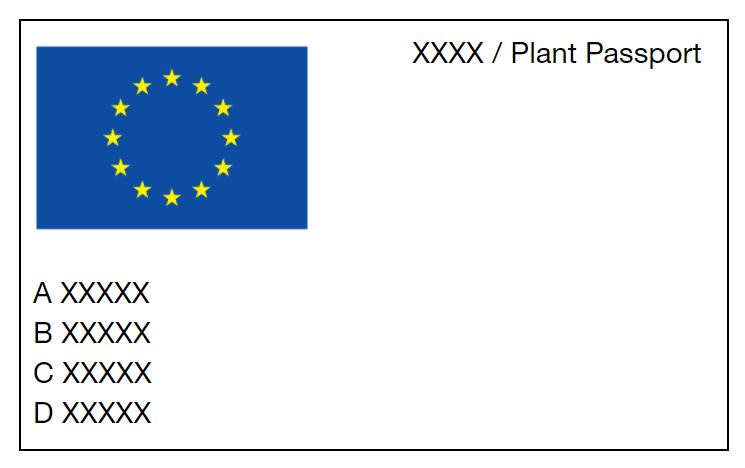
In practice, this means that plant passports must take the form of a rectangle or square which, in addition to the inscriptions (Plant Passport / Plant passport) and a black-and-white or color variation of the Union flag in the upper left corner, contains information marked with the following labels:
A - botanical name of the plant (of the given plant species or taxon, or in the case of plants and plant products, possibly the name of the item concerned, optionally also the variety name)
B – registration number (two-letter country code)
C – traceability code (of the plant, plant product or other object concerned)
D – two-letter code of the country of origin
You can easily handle plant passports with the help of our printers
As mentioned above, although the plant passport has a strictly defined format, it may be printed on any device and material suitable for printing the elements specified in the relevant national legislation. Of course, provided that it is easily visible and clearly distinguishable from other information or labels.
The plant passport must also be clearly legible and must contain information that is immutable and durable. A number of devices from our offer can easily meet all the mentioned requirements, but among them we have nevertheless selected the professional label printer Brother QL-700, which stands out with an attractive price and extensive printing options.
The Brother QL-700 printer prints on self-adhesive labels or paper rolls. The device can print up to 93 address labels per minute and offers integrated PT Edit Lite software, which launches immediately after being connected to any computer. The Brother QL-700 printer has a wide range of applications; in addition to plant passports, you can use it to print address and shipping labels, labels for binders, CD/DVD media, labels for test tubes, etc.
The label printer Brother QL-800 or the Brother QL-810W with Wi‑Fi will provide equally perfect service when labeling plants.
Of course, you can also purchase suitable labels and tapes from us for the brands of label printers mentioned, as well as for many others.